
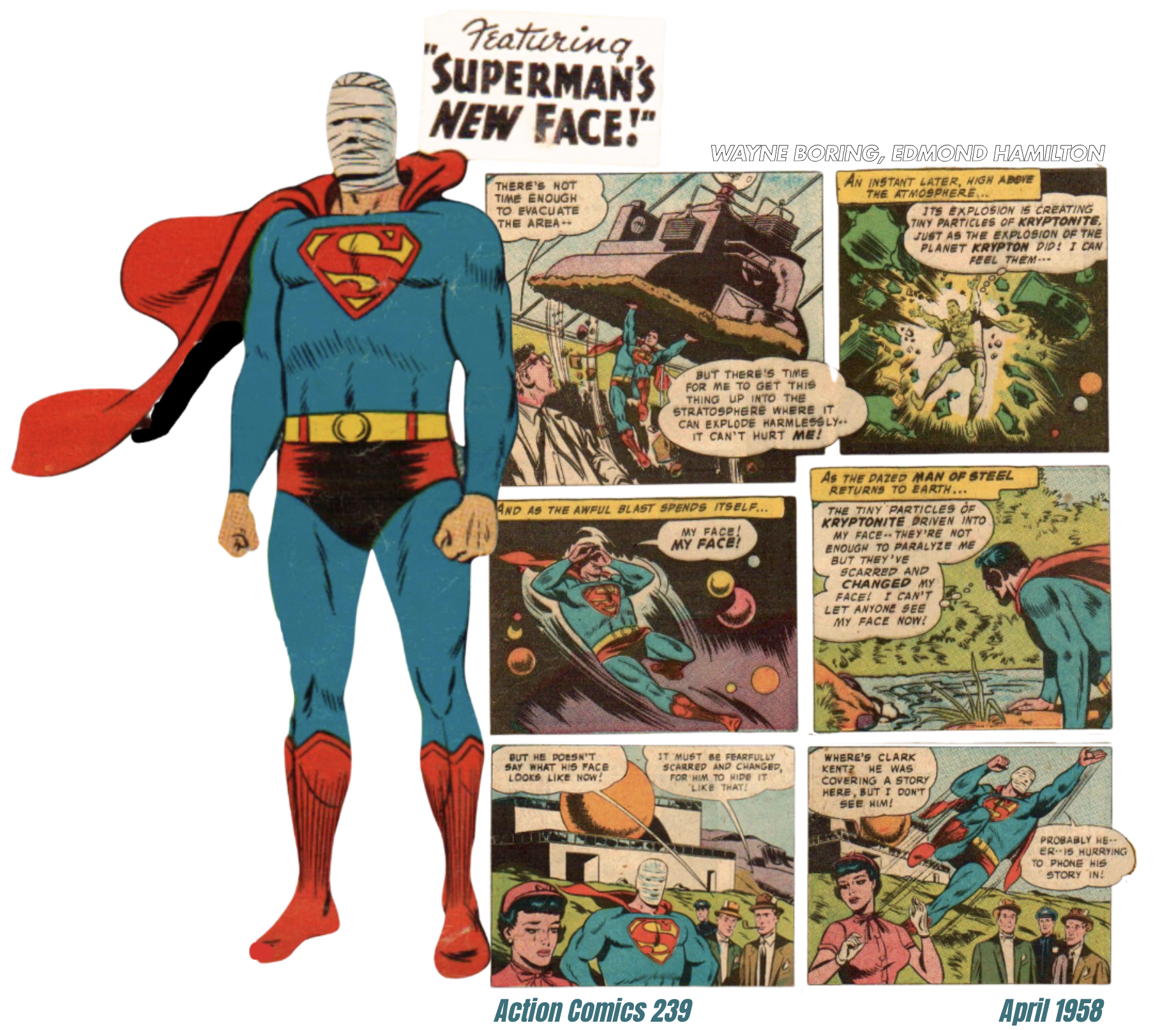
Superman editor Mort Weisinger never minded borrowing the high points of a good melodrama.
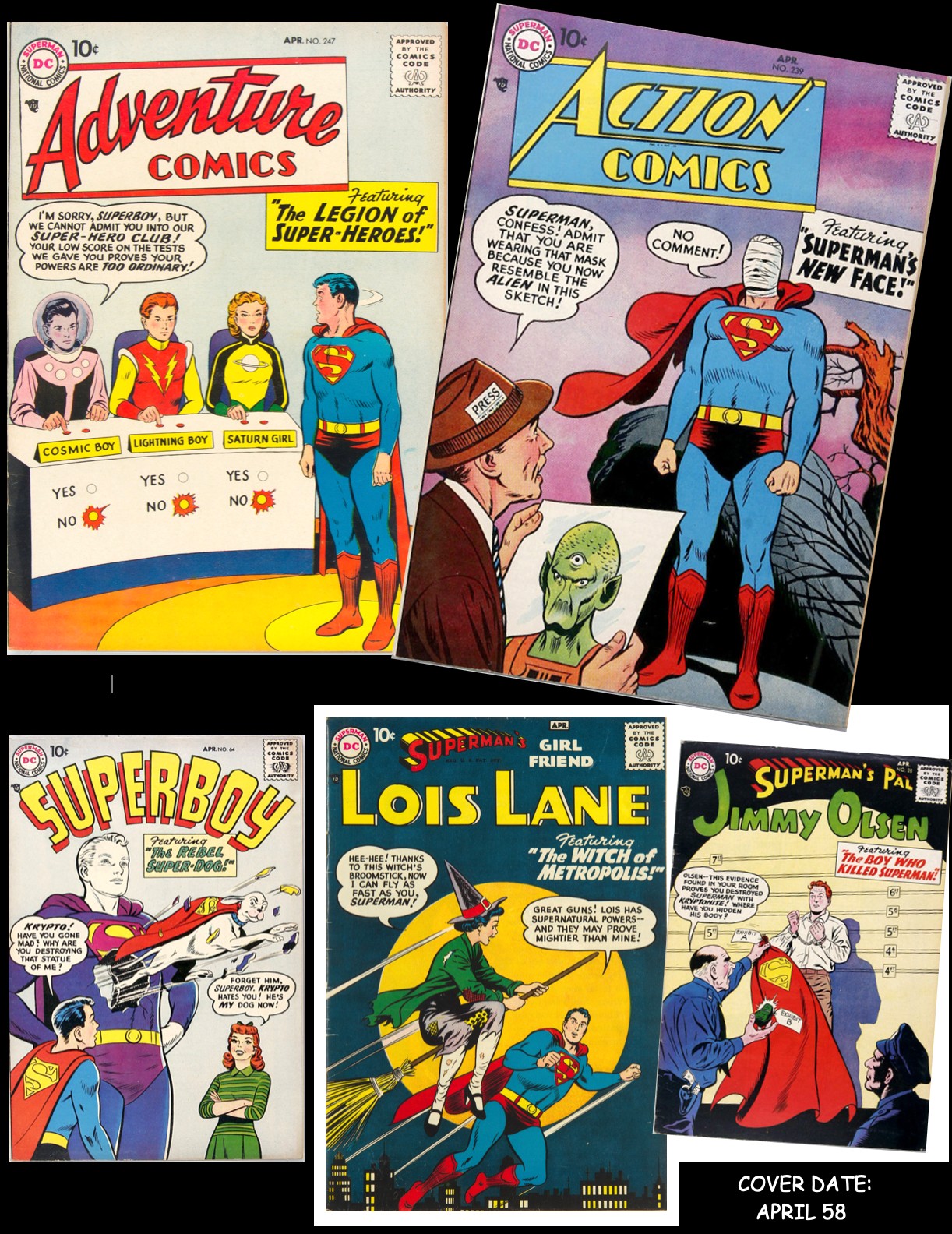
For example, the story “Superman’s New Face” (Action Comics 239, April 1958) has a distinct Phantom of the Opera vibe, and a couple of issues later, in Action Comics 258, Lois Lane and Superman will reenact “The Beauty and the Beast.”
In 1925 — when writer Edmond Hamilton was 21 years old and Weisinger a mere 10 — American audiences thrilled to see Mary Philbin tear the mask off the hideous face of Lon Chaney in The Phantom of the Opera, a silent film based on Gaston Leroux’s 1910 novel.
And a quarter of a century later, Hamilton and Weisinger would give Lois a chance to play the same scene, with Wayne Boring illustrating.
When Dr. Horton’s new “atom generator” runs out of control, Superman flies it into the stratosphere, where it explodes. But the blast has created particles of kryptonite, which are driven into Superman’s face.
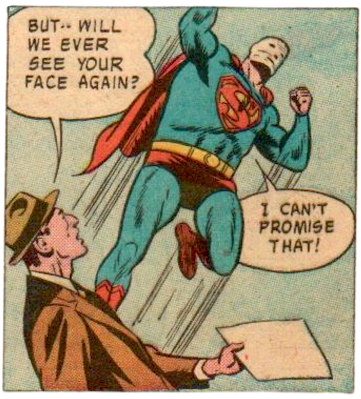 Gazing into his reflection in a pond, the dazed Superman thinks, “They’re not enough to paralyze me, but they’ve scarred and changed my face! I can’t let anyone see my face now!”
Hiding his face behind mummy-like bandages, Superman seeks a cure for his condition, but to no avail. While he rescues a tanker, the bandages are burned away, so he molds himself an iron mask from the metal of a wrecked ship at the bottom of the sea.
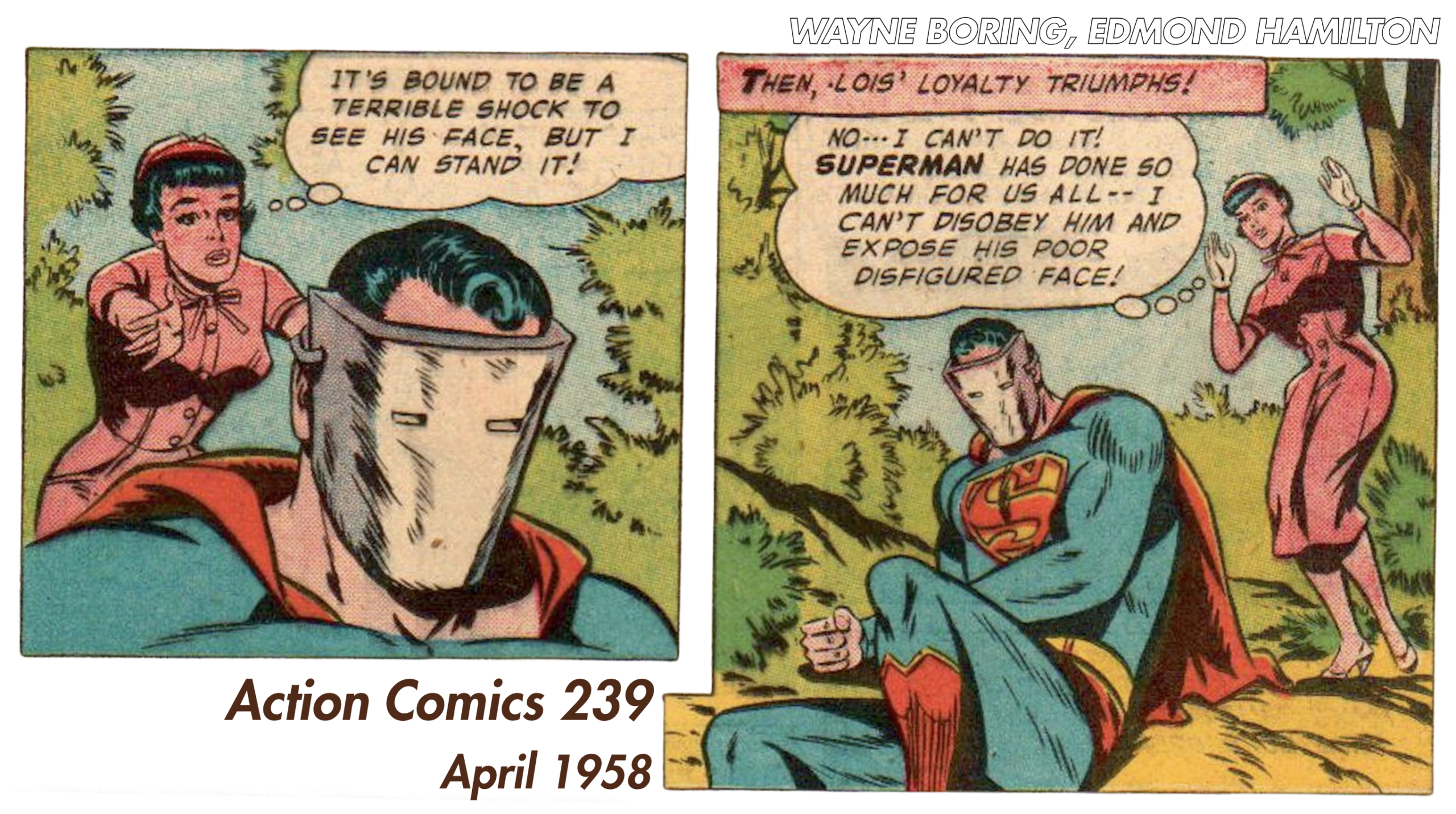
While Superman sits brooding over his dilemma, Lois approaches him unnoticed, intending to unmask him and find out what’s going on.
But to her credit, she doesn’t.
“No — I can’t do it!” Lois thinks. “Superman has done so much for us all — I can’t disobey him and expose his poor, disfigured face!”
“(I)t is an sf mystery: we do not know what transformation has happened to Superman’s face, and it takes much of the story till we find out,” noted comics historian Michael Grost. “Science fiction mysteries were a Hamilton specialty. So were masked mysterious people. This is a theme we associate with Sir Walter Scott: for example, the helmeted Black Knight in Ivanhoe (1820), whose identity is unknown through much of the novel.”
It’s not until the tale’s conclusion that we learn the nature of Superman’s “disfigurement” — the name “Clark Kent” has been burned right in the middle of his forehead.
In the first panel of the story, Daily Planet editor Perry White had been passing out new metallic stencil press passes, and Dr. Horton had laid Clark’s down on the atom generator just before the explosion. That’s what caused the branding.
Realizing that another such atomic reaction might clear up his skin condition, the Man of Tomorrow detonates a planetoid of pure uranium. Voila!
The story was popular enough to be reprinted a mere three years later in the third Superman Annual (The Strange Lives of Superman!). It can also be found in the trade paperback Superman in the Fifties.
About Author
