 I’ll start with a confession: I’m not a fan of Dungeons & Dragons 5th Edition.
It’s a homogenized creation — designed, it seems, to appease the legions of players who want to do everything: cast spells, wield greatswords, and defy racial or class limitations. The result is a system where characters can often feel like clones rather than a diverse party of adventurers bound by their differences.
So, when I pick up a D&D 5E supplement, I’m always looking to see how well it might slot into earlier editions — when character diversity and class identity still mattered.
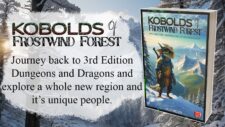
That’s what initially drew me to The Kobolds of Frostwind Forest, written by Canadian author and designer Mark Charke. Even better, this one was crafted with 3rd Edition in mind — a major win for me right from the start.
Charke’s credentials are impressive. As noted in his Kickstarter bio, he “has been writing since the early ’90s and has published over 70 works, including 2nd, 3rd, 4th, and 5th Edition and Vampire: The Masquerade manuals, several novels, and a LARP card game.” That pedigree alone suggested Frostwind Forest would offer something of substance — and the promise of a fresh take on Kobolds sealed the deal.
Traditionally, Kobolds rank near the bottom of the fantasy hierarchy — little more than an early-level nuisance, a speed bump for novice adventurers, or cannon fodder during a villain’s escape scene. Dungeon Masters rarely give them more thought.
But Charke challenges that perception.
In The Kobolds of Frostwind Forest, he reimagines these creatures as a diverse, multifaceted race — not merely evil, cowardly pests with pointy sticks, but individuals capable of good, neutrality, and complex motives.
The Kickstarter campaign summed it up nicely:
“This is a story about the underdogs — the little race that has long served not as villains, but as the pushed-aside, annoying minions of villains. In Frostwind Forest, the Kobolds have become something more, guided and influenced by forces beyond them. Having a teacher to elevate them, they may actually become a threat in their own right. Protected by their resistance to cold, the Kobolds are hidden in Frostwind Forest, where their numbers and their might are growing. They aren’t all good. Not even most of them are good. The important thing is that some of them are good — and they are trying.”
Now, simply expanding a race’s alignment spectrum wouldn’t be groundbreaking on its own — alignment has always been more about player behavior than character sheet boxes. But Frostwind goes further.
Charke loads the supplement with new spells, races, prestige classes, mutations, and even “maggot therapy rules” — yes, you read that correctly — all wrapped around a detailed setting filled with unique personalities, politics, and power struggles.
The world-building is robust, too. The Frostwind Forest teems with life — home to three dragons, a dryad venerated by the Kobolds, powerful treants, giants, and human explorers — all shaping the ecosystem and culture of this icy realm.
The result is a supplement that inspires. It makes you want to roll up a Kobold hero and take them adventuring — or, if you’re the Game Master, to send your party into Frostwind Forest and let them grapple with the realization that not all Kobolds are the same.
This is the kind of D&D supplement that enhances the game rather than diluting it. It adds texture, imagination, and purpose — not just more sameness blended into the ever-smoothing stew of modern editions.
About Author
Calvin Daniels is a Saskatchewan-born, self-taught journalist. He is currently Editor of Yorkton This Week, with 35-years in the newspaper business.

A Fresh Look at Kobolds for an RPG Classic
It’s a homogenized creation — designed, it seems, to appease the legions of players who want to do everything: cast spells, wield greatswords, and defy racial or class limitations. The result is a system where characters can often feel like clones rather than a diverse party of adventurers bound by their differences.
So, when I pick up a D&D 5E supplement, I’m always looking to see how well it might slot into earlier editions — when character diversity and class identity still mattered.
That’s what initially drew me to The Kobolds of Frostwind Forest, written by Canadian author and designer Mark Charke. Even better, this one was crafted with 3rd Edition in mind — a major win for me right from the start.
Charke’s credentials are impressive. As noted in his Kickstarter bio, he “has been writing since the early ’90s and has published over 70 works, including 2nd, 3rd, 4th, and 5th Edition and Vampire: The Masquerade manuals, several novels, and a LARP card game.” That pedigree alone suggested Frostwind Forest would offer something of substance — and the promise of a fresh take on Kobolds sealed the deal.
Traditionally, Kobolds rank near the bottom of the fantasy hierarchy — little more than an early-level nuisance, a speed bump for novice adventurers, or cannon fodder during a villain’s escape scene. Dungeon Masters rarely give them more thought.
But Charke challenges that perception.
In The Kobolds of Frostwind Forest, he reimagines these creatures as a diverse, multifaceted race — not merely evil, cowardly pests with pointy sticks, but individuals capable of good, neutrality, and complex motives.
The Kickstarter campaign summed it up nicely:
“This is a story about the underdogs — the little race that has long served not as villains, but as the pushed-aside, annoying minions of villains. In Frostwind Forest, the Kobolds have become something more, guided and influenced by forces beyond them. Having a teacher to elevate them, they may actually become a threat in their own right. Protected by their resistance to cold, the Kobolds are hidden in Frostwind Forest, where their numbers and their might are growing. They aren’t all good. Not even most of them are good. The important thing is that some of them are good — and they are trying.”
Now, simply expanding a race’s alignment spectrum wouldn’t be groundbreaking on its own — alignment has always been more about player behavior than character sheet boxes. But Frostwind goes further.
Charke loads the supplement with new spells, races, prestige classes, mutations, and even “maggot therapy rules” — yes, you read that correctly — all wrapped around a detailed setting filled with unique personalities, politics, and power struggles.
The world-building is robust, too. The Frostwind Forest teems with life — home to three dragons, a dryad venerated by the Kobolds, powerful treants, giants, and human explorers — all shaping the ecosystem and culture of this icy realm.
The result is a supplement that inspires. It makes you want to roll up a Kobold hero and take them adventuring — or, if you’re the Game Master, to send your party into Frostwind Forest and let them grapple with the realization that not all Kobolds are the same.
This is the kind of D&D supplement that enhances the game rather than diluting it. It adds texture, imagination, and purpose — not just more sameness blended into the ever-smoothing stew of modern editions.
About Author
Calvin Daniels
Calvin Daniels is a Saskatchewan-born, self-taught journalist. He is currently Editor of Yorkton This Week, with 35-years in the newspaper business.
See author's posts