 In general, connection games — those where you’re trying to string a line of something from one side of the board to the other — tend to bore this reviewer.
While many rave about Hex — likely the granddaddy of the mechanic — I’ve never found it particularly engaging. That said, a few connection games rise above the norm. Tak, for example, is a top-shelf design and among the best abstract strategy games of this millennium, and PUNCT also stands out from the crowd.
So when Meteor Shower from Queensell (queensell.com) arrived, I wasn’t exactly sure what to expect.
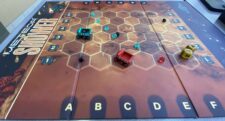
At its core, Meteor Shower is a connection game — but with a “mining Mars” theme layered on top, which at least gave it an initial spark of interest.
Inside the box, the presentation is quite nice. The game board is boldly colored and reversible: one side features a smaller grid for quick sessions, while the other offers a larger field for longer play.
Players can roll dice to have a meteor fall on the hex matching the roll, or they can roll out neat little toy buggies to gather meteors and transport them back to form their line across the board.
On the small board, a few unlucky die rolls dropping meteors too close to your opponent — this is a two-player game — can spell disaster. It happened to me, and Trevor stomped me soundly. The larger board mitigates this somewhat by requiring more pieces to complete a line, but dice rolls still influence the flow of Meteor Shower.
Once collected, the meteors change to your color — bright plastic “gems” that match the vibrant feel of the board nicely.
The buggies move according to one of four preset movement patterns, each covering three hexes. The patterns are printed right on the board, which helps, though we still spent more time than was fun double-checking whether we were moving correctly.
And on the smaller board, getting boxed in with no legal move is a frustrating way to end the game. In the end, Trevor and I decided to ignore the pattern restriction altogether, instead using a simple house rule: you must move exactly three hexes, and you can’t cross the same hex twice. It feels more natural and free-flowing.
So, first thing — skip the small board except for your initial test game. The larger board simply offers a better, more engaging experience. Try the printed movement patterns, but if you find them restrictive, our house rule might suit you better.
In the end, Meteor Shower is certainly better than Hex (though most games are, in my opinion), but it’s not on the same planet as Tak. It falls somewhere in between — inching just above the halfway mark — enough to earn a cautious recommendation, especially if the connection mechanic is your thing.
About Author
Calvin Daniels is a Saskatchewan-born, self-taught journalist. He is currently Editor of Yorkton This Week, with 35-years in the newspaper business.

Far More Fun With This Connection Game Than Most
While many rave about Hex — likely the granddaddy of the mechanic — I’ve never found it particularly engaging. That said, a few connection games rise above the norm. Tak, for example, is a top-shelf design and among the best abstract strategy games of this millennium, and PUNCT also stands out from the crowd.
So when Meteor Shower from Queensell (queensell.com) arrived, I wasn’t exactly sure what to expect.
At its core, Meteor Shower is a connection game — but with a “mining Mars” theme layered on top, which at least gave it an initial spark of interest.
Inside the box, the presentation is quite nice. The game board is boldly colored and reversible: one side features a smaller grid for quick sessions, while the other offers a larger field for longer play.
Players can roll dice to have a meteor fall on the hex matching the roll, or they can roll out neat little toy buggies to gather meteors and transport them back to form their line across the board.
On the small board, a few unlucky die rolls dropping meteors too close to your opponent — this is a two-player game — can spell disaster. It happened to me, and Trevor stomped me soundly. The larger board mitigates this somewhat by requiring more pieces to complete a line, but dice rolls still influence the flow of Meteor Shower.
Once collected, the meteors change to your color — bright plastic “gems” that match the vibrant feel of the board nicely.
The buggies move according to one of four preset movement patterns, each covering three hexes. The patterns are printed right on the board, which helps, though we still spent more time than was fun double-checking whether we were moving correctly.
And on the smaller board, getting boxed in with no legal move is a frustrating way to end the game. In the end, Trevor and I decided to ignore the pattern restriction altogether, instead using a simple house rule: you must move exactly three hexes, and you can’t cross the same hex twice. It feels more natural and free-flowing.
So, first thing — skip the small board except for your initial test game. The larger board simply offers a better, more engaging experience. Try the printed movement patterns, but if you find them restrictive, our house rule might suit you better.
In the end, Meteor Shower is certainly better than Hex (though most games are, in my opinion), but it’s not on the same planet as Tak. It falls somewhere in between — inching just above the halfway mark — enough to earn a cautious recommendation, especially if the connection mechanic is your thing.
About Author
Calvin Daniels
Calvin Daniels is a Saskatchewan-born, self-taught journalist. He is currently Editor of Yorkton This Week, with 35-years in the newspaper business.
See author's posts