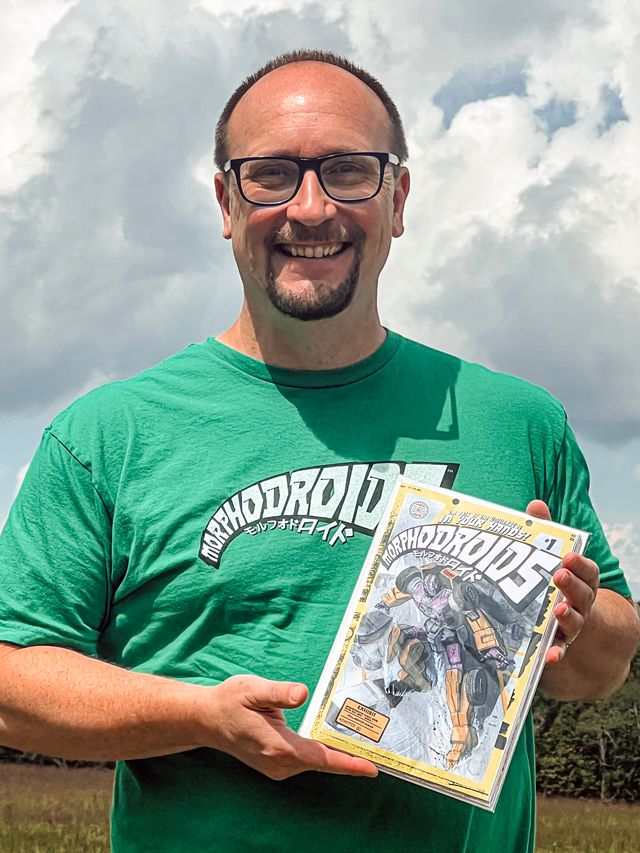
 I’m here with Keith Finch, writer of a new 96 (ninety-six) page comic book coming out based on the mid-1980s Morph-o-droid toys, toys that were vehicles like cars and trucks, which, when the need required it, morphed into giant robots!
I did a little bit of research online about this this afternoon. In 1984, the Transformers toys burst upon the scene (and later, correct me if I’m wrong), came a Transformers animated TV series, followed years later by Transformers comic books and numerous big-budget theatrical movies.
One of the comic stores where I shop for new comic books is called Giant Robot Comics. It is located in the Woodlawn area of Dartmouth, Nova Scotia, Canada.
The store’s owner is Daryl Wall, who collects everything to do with Transformers: toys, comics, movies, et al. He even has a huge glass case in the store, full of several hundred of these Transformers robots, of all different types and sizes, hence the name of this particular comics specialty store, ‘Giant Robot Comics.’ He is a huge fan and collector of Transformers.
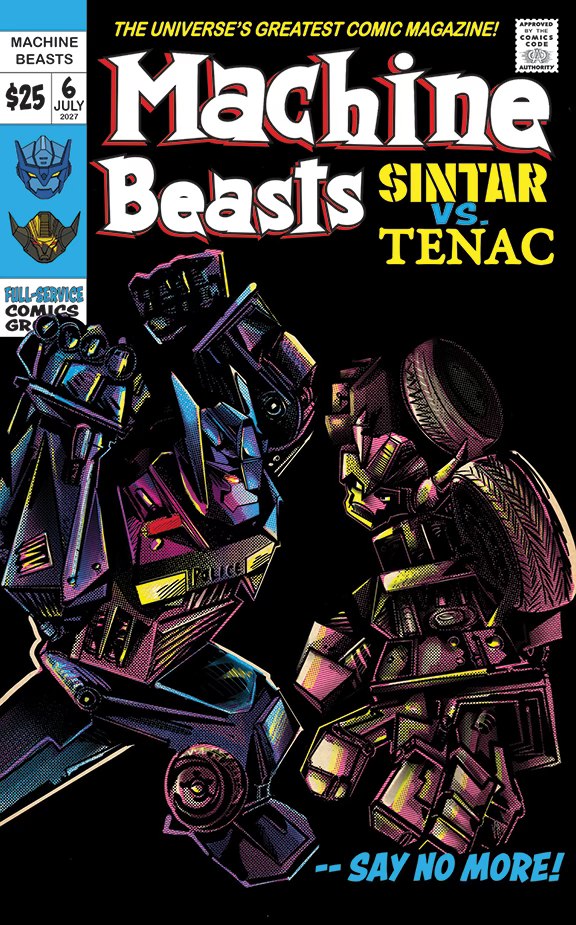 Here is a timeline of when all three of the similar ideologies of transforming toy lines came out, according to my very limited, quick research on these three lines of toys, earlier today:
Go Bots: Starting 1983-1987.
Transformers: Starting 1984-Present
Morph O Droids: Starting 1985
While the much more well-known Transformers toys started in 1984, Morph O Droids (spelled originally that way, with three separated words, if you were to count the capital letter ‘O as a word) started a year later, in 1985.
However, there were toys called Go Bots that came out in 1983, preceding both Transformers AND Morph O Droids.
And then you have The Zeroids and The Micronauts, which include at least one giant robot, and there are undoubtedly many others. But Zeroids and Micronauts were not transforming robots.
Keith Finch: I believe the Transformers comic book actually was released before the cartoon. If memory serves, Marvel’s Bob Budiansky worked over a holiday weekend to create names and the general profiles for most of the characters. Bill Mantlo wrote the first couple of issues of the Transformers comic book with Budiansky as Editor, but Bob took over the writing chores and is largely considered one of the key architects of the Transformers’ lore. Netflix has an episode of the series ‘The Toys That Made Us’ that is a really good overview of the transforming robot genre, and Transformers, specifically.
 1st: Fair enough, Keith. My ‘brief research’ on the internet regarding these starting in the early to mid 1980s robot toy lines was very brief, like ten or fifteen minutes, max. I know almost nothing about these toy lines. Please educate our readers about them. I have seen one or two of the Transformers live-action movies, and that’s about it.
Keith: I’m certainly far from being an expert on the subject, but there is a long history in Japanese culture, in particular, of a belief that inanimate objects are more than they appear. Again, I’m far from an expert here, but this manifests itself in Tsukumogami in Japanese folklore — tools that gain a spirit. It isn’t a huge leap to see how that could be applied to toys that change from ordinary vehicles to powerful sentient robots. So, there’s a long tradition of Japanese robot toys. Enterprising American toy executives saw potential in repackaging many disparate Japanese toy lines into cohesive brands like GoBots and Transformers with built-in narrative mythologies – an important addition to the American versions of these toys, which were, oftentimes, virtually identical to their Japanese counterparts. The inclusion of the narrative lore and mythology certainly made these toys more attractive to American children, who were accustomed to that type of toy introduction.
GoBots was introduced first on the American market, pitting the ‘Guardians’ against the ‘Renegades’ amidst an intergalactic civil war.
Transformers followed with two separate factions, the Autobots and Decepticons, who left their home world of Cybertron to search for new energy sources, and they crashed on Earth.
After that…there were a LOT of toy lines released; many of them did not have their own mythologies, but some did. Morphodroids did – the back of each toy’s packaging included brief bios of each of the toys, and whether they were part of the evil Maldroid Empire, or the benevolent United Beniforce Galaxies.
1st: The Transformers were giant robots from outer space. Which leads me to my first question: Keith Finch, your PDF press release you sent me indicates that you are creating this new Morph O Droids giant, 96-page comic book, along with twenty artists. I am assuming, then, that you are writing the whole thing, accompanied by twenty artists?
 Keith: That’s right. I’ve written the entire series and collaborated with a diverse group of artists from around the world to bring it to life. The bulk of the comic in this inaugural 96-page ‘Deluxe’ edition was illustrated by Sergio Ríos, a talented Mexican artist known for his work with Cryptorama Comics. John Burgin adds his signature energy, familiar to fans of his self-published FrogBoy series, in a fun back-up story.
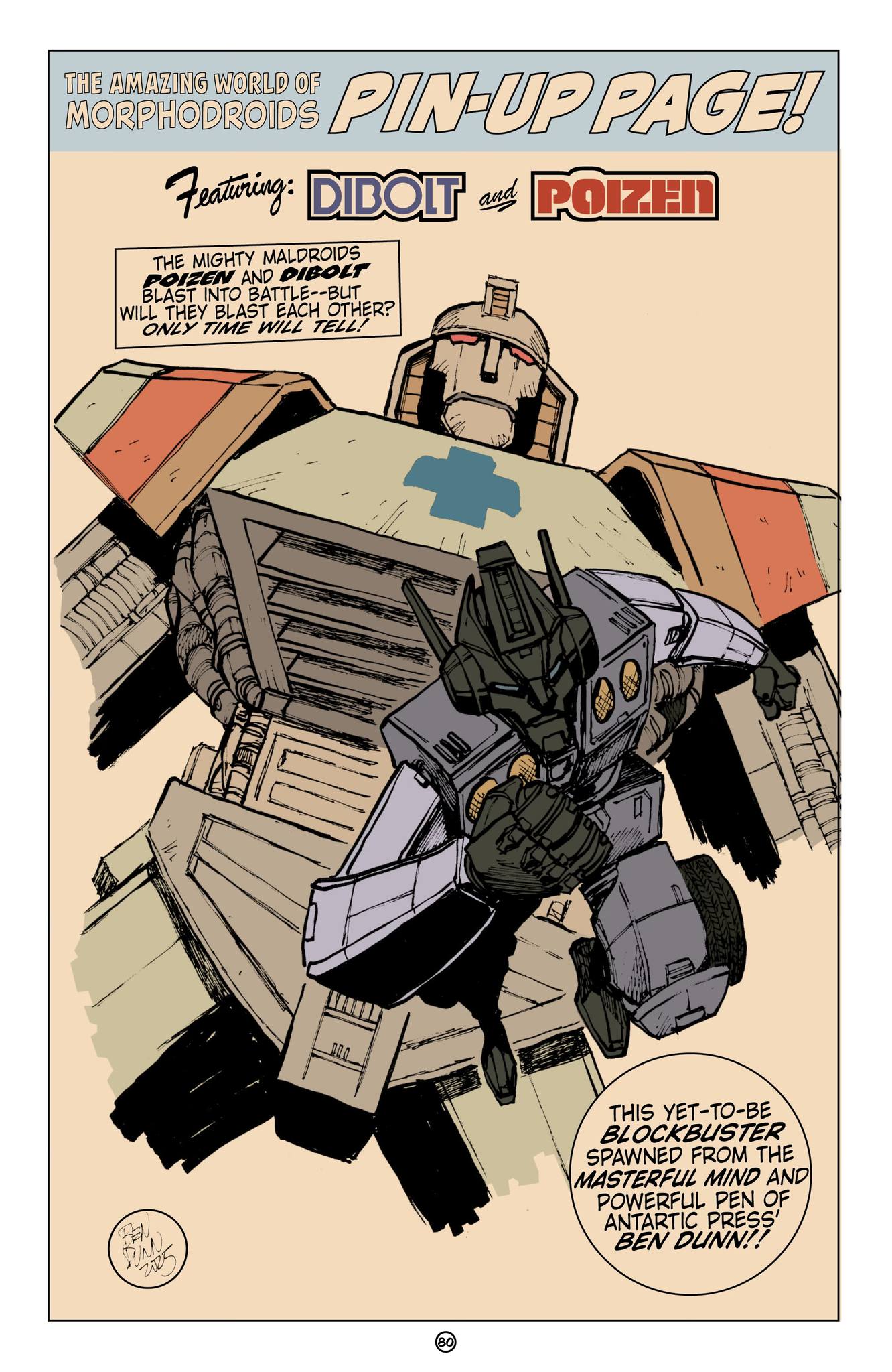
Fifteen artists contributed pin-ups — not as filler, but as vibrant character spotlights that enrich the world, especially for those who appear briefly in the main story. The cover is by Ryan Miller, whose work includes Transformers store exclusives and the upcoming Titanomachy, which I highly recommend searching out.
To round out the team, I also worked with character designers, a storyboard artist, and a technical illustrator. It truly took a village to do this project justice.
1st: Sounds interesting. I get and completely understand the inclusion of a technical illustrator, as these are transforming robots. But, let me ask you this: Why the inclusion of a storyboard artist?
Keith: The technical illustrator’s contribution didn’t have much to do with the robots themselves, actually. The Morphodroids comic book is taking a meta-approach with the narrative; within the Morphodroids comic book universe, the toys were a real thing, they existed in OUR world, and the toys weren’t the only things that were real! All that is to say, I’m trying to reinforce the reality of this world through artifacts and documents within the backmatter. One of those artifacts was an item that benefited from a more technical drawing, like you might see in a patent application, so a technical illustrator was brought on board to fill that particular need.
1st: That makes perfect sense.
Keith: As far as the storyboard artist, that’s an interesting one. When I started this project, there wasn’t any representation of a Morphodroid’s commercial on the internet. I searched for pretty much anything Morphodroids-related, and I never came across one…but the Morphodroids toy creator had an original 1st Generation VHS copy that I had digitized. I planned to release that as part of this Kickstarter campaign’s promotion, but in the interim, someone else had released a copy of the commercial from a television airing on YouTube.
I wanted to include something about the commercial in the book, so I had a storyboard artist recreate what the storyboards for the commercial might have looked like.
 Morphodroids is more than just a comic book; it’s a celebration of the toy line that inspired it. The book includes photos of the toys, vintage ads, an exclusive interview with the toy line’s creator, and loads of back matter: character profiles, secret government files, and more. For readers who dive into that material, the world of Morphodroids becomes much richer and more immersive. This is an admittedly obscure niche, but in a broader sense, I feel like it’s important that we document as much of these types of things as possible to create artifacts for those who come after us.
1st: Well, this project sure sounds like a full, comprehensive introduction to the Morphodroids, and it should be a hit, then, with Transformer fans!
Keith: I’d like to think the project has something that would appeal to people from all walks of life, Transformers fans certainly included!
1st: I take it the name of this has been changed to Morphodroids, as in the press release?
Keith: The original branding varied — Morph-O-Droids, Morph-o-droids, and Morphodroids. I chose the streamlined ‘Morphodroids’ for clarity and searchability. Back in 1985, website addresses and search engine optimization weren’t concerns, but today, discoverability is everything.
 1st: That makes perfect sense, also by the way. Keith, it has just now occurred to me, that it seems I remember that, sometime in the 1980’s, I recall reading about the existence of a uniquely British Marvel long-running Transformers comic book series, which were never, ever reprinted in The Americas, so that very few Americans or Canadians (like myself) would ever have gotten to see nor read them. Do you know anything about them, and have you ever seen any of them? I just researched this on the internet, and it turns out that the Marvel UK comic book title Transformers ran for a whopping 332 issues, with a storyline (writing and art) completely separate from the Marvel U.S. Transformers comics series!!!
Keith: I certainly don’t pretend to be an expert on the subject, but I’m familiar with the Marvel UK Transformers series. The Marvel UK series was published on a more frequent schedule than the American Transformers series, so the Marvel UK staff (led by writer Simon Furman) developed stories that would fit in between the stories being told within the American series.
1st: You are right. British/ UK comic book series from all publishers, most of which were weeklies.
Keith: Simon Furman’s contributions to Transformers weren’t limited to the Marvel UK series; he was the lead writer on the American series as well, for an extended period of time.
I’ve seen some of the Marvel UK Transformers comics, and they are a lot of fun; certainly a bit different from the more familiar (to me) American comics, but great in their own way!
 Skybound recently had a crowdfunding campaign for collected editions of the Transformers US and UK series that raised over $4.6 million (the biggest comic book-related crowdfunding campaign to date), so there is certainly an appetite for Transformers, some 40 years after their introduction into the market!
1st: I didn’t know that; that’s great! In fact, numerous other Marvel UK titles never saw reprints anywhere else, like Captain Britain Weekly (starting in 1976), Hulk Weekly, and several others. Some of these titles have been reprinted in Marvel Omnibuses decades later, but most of them (including Marvel UK Transformers) have not.
Keith: Yes, it’s unfortunate that even in this day and age, where it seems like you can find and purchase virtually anything ever created, there are comics that are difficult to obtain. Fortunately, as I mentioned, Skybound will be releasing the complete Marvel UK Transformers series as part of their hugely successful crowdfunding campaign.
1st: Perfect! And then there were Marvel’s Shogun Warriors comics of the 1970s, which, if memory serves, were ALSO transforming robots! I remember buying all of that series as a kid, when they first came out. What can you tell both me and our readers about the original storyline of Morphodroids, if there was one? Were the Morphodroids also from outer space?
Keith: Morphodroids #1 throws readers straight into the action. A dormant Morphodroid named Sagos is reawakened by a convergence of events. Without spoiling too much, the central characters are refugees from an interplanetary war. And no, they’re not the first Morphodroids to make their presence known on Earth!
On the surface, it’d be easy to assume that Morphodroids is just another in a long line of transforming robot comics, but honestly, Morphodroids has just as much in common with Stranger Things and X-Files as it does with Transformers or GoBots.
Story
Morphodroids – Then and Now
The Lost Toy Line of 1985
In the wake of the transforming robots craze led by Transformers and GoBots, Morphodroids were introduced. The toy line was unique in that the toys could be morphed from vehicle to robot mode using a tethered remote control. Despite the development of a television commercial and a prominent print ad that ran in Marvel Comics, the line came and went like so many others.
 The Comic Revival of 2025
Now the Morphodroids are returning in comic book form in the first ALL-NEW Morphodroids content since the toy’s original release in 1985!
The Deluxe Edition of this comic includes 30 pages of comic book content, photography of the original toys, an interview with the toy creator, character profiles, and a bevy of pin-ups and other goodies provided by an international group of artists with a wide variety of styles. Striking a balance between dense content and eye-melting visuals, Morphodroids strives to be a great investment of your hard-earned money!
1st: I used to watch The X-Files, in its day, all the time. Probably most people who watched science fiction-like television did so, in addition to other audiences. However, I only know Stranger Things by its title, and nothing else. Can you tell our readers and me, who are not familiar with Stranger Things, a brief description of what that was about? Also, was it a movie, a TV series, or a comic book? Consider your answer to be a brief segue, and then we will get right back to the main topic, I promise, which is, of course, The Morphodroids!
Keith: Stranger Things is a Netflix series that includes supernatural elements and investigative drama not unlike The X-Files, but done primarily by and through a group of children.
Similarly, Morphodroids centers around a group of children who are thrown into an adventure that prompts a full-fledged investigation. Tonally, I tried to create characters and their relationships that would resonate with readers in much the same way audiences have reacted to the Stranger Things cast.
1st: I understand that your Morphodroids comic book will be ‘revising’ the Morphodroids storylines. Kindly tell me and our readers about these characters, what their mission is, why they were created, and so forth. Have they come to planet Earth, or do they operate, umm, “in a galaxy far, far away”? Kindly explain this to us in a way assuming I know nothing about this team, which, by the way, would be factually correct.
Keith: The comic builds on the original toy lore: nine Morphodroids split into two factions, the malevolent Maldroid Empire and the heroic United Beniforce Galaxies.
These beings arrived on Earth in the early 1980s, fleeing a galactic conflict. They were active for a time, then faded into obscurity … until now. This revival explores their mission, their origins, and their place in a much larger universe.
 1st: I take it that you were, perhaps, a Go Bots/Transformers/ Morphodroids fan from the beginning?
Keith: I was the right age to enjoy the transforming robot craze: GoBots, Transformers, Morphodroids, and the rest. But I wouldn’t call myself a “superfan.” I had a few of the toys, watched the cartoons, and read the comics. My deeper interest in Morphodroids came later, sparked by a unique blend of nostalgia, curiosity, and creative opportunity.
1st: I’d like to, if I may, ask you some biography-type questions, such as: where are you from (where do you live?), where were you born, how old are you, and when and why did you first discover and get into comic books, as a hobby?
I always like to ask these types of questions of my interviewees, for the reason that the variety of answers I get from my interviewees ranges far and wide!
Keith: I’m 50, and I have lived in the Chattanooga, Tennessee area my whole life.
Comics were always around — my dad was a fan of Conan the Barbarian, Savage Sword of Conan, and Swamp Thing. I gravitated toward Saturday morning heroes like Spider-Man, Hulk, and Batman.
1st: As was I, of all of those, and a lot more!
Keith: I didn’t have a huge collection, but the ones I did own were read to pieces, literally.
1st: Where did you go to school, and is this your first written comic book? If not, can you tell us what else you have written that has seen publication?
 Keith: I earned a BFA in Graphic Design from the University of Tennessee at Chattanooga. Back then, I didn’t fully grasp what a graphic designer did, but it felt like a stable, creative path, and it’s served me well.
1st: So, from your telling us that you have a Bachelor of Fine Arts in graphic design, I take it, then, that you are an artist, as well? If so, then you and I have that in common, in that we are both published writers and artists. Tell us about your art. And perhaps you could share some in this interview? If so, our readers would love that!
Keith: This is my first published comic book as a writer. Previously, I lettered and designed Deathslinger, released last year by Cosmic Lion Productions, and I contributed pin-ups, lettering, and additional bits and bobs to several independent comic projects over recent years.
I do have an art degree, but I’m hesitant to think of myself as a practicing Capital A ‘Artist’ — most of my work tends to be homage-type pen and ink work. I am looking to get back into doing art more regularly, so maybe one day I’ll feel like that Capital A ‘Artist’! Even if I’m not doing the art, I do think having at least a basic understanding of what is involved in creating the visuals for the project helps me as a writer to provide relevant information to my collaborators.
I usually provide thumbnails with panel breakdowns as a starting point in my creative process. Those are typically shared with my artist collaborators, but they are used as a starting point. The artist is always free to add or adjust, as it makes sense for the story.
1st: What inspired you to do a comic book about the
Morphodroids?
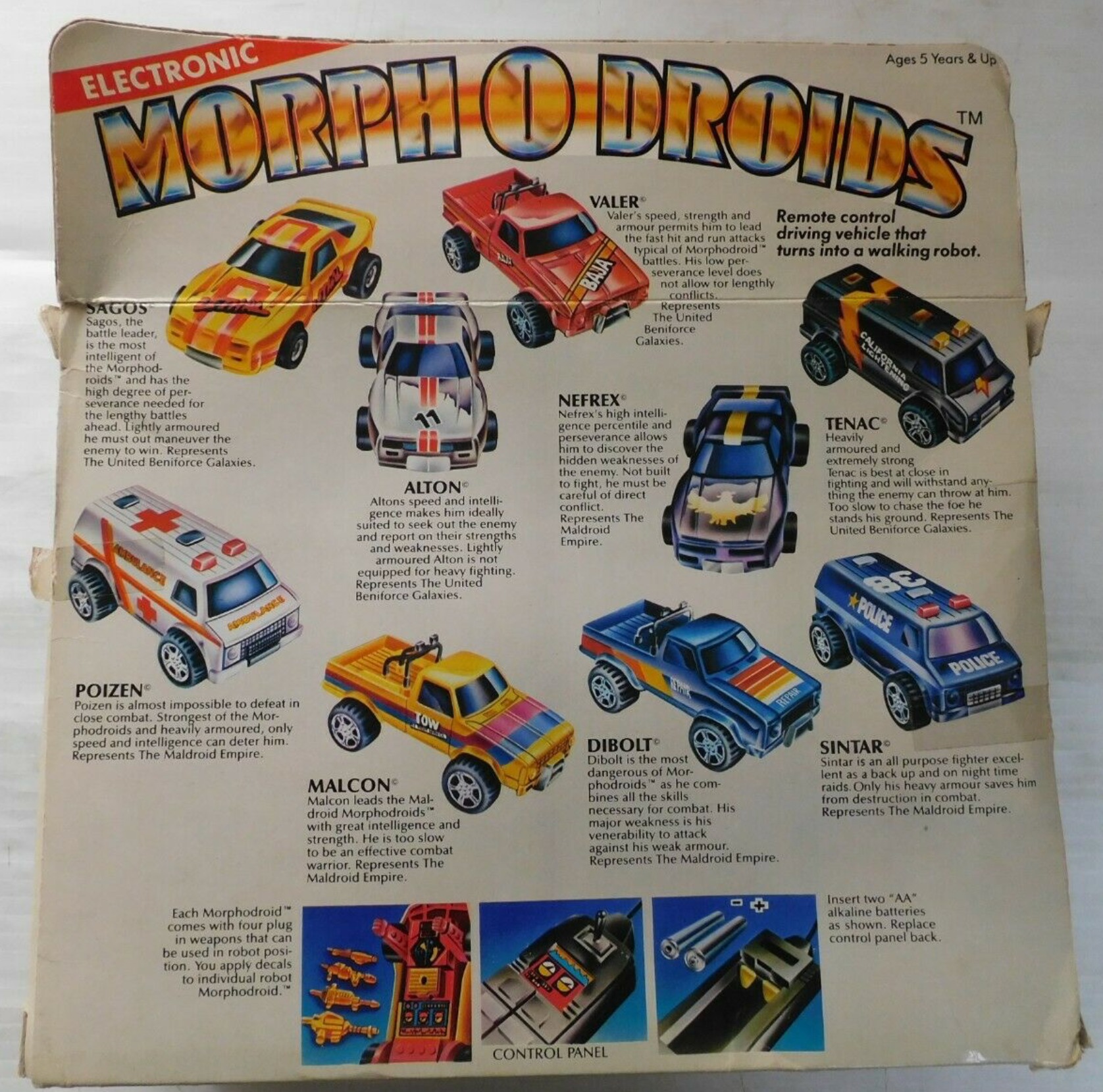 Keith: During the early COVID lockdowns, I was organizing my comics collection, and I noticed an ad for Morphodroid toys on the back of several Marvel Comics issues. I’d never heard of them, despite my having been the perfect age when they launched. That discovery led to some deep-dive sleuthing, and eventually, I connected with the toy’s original creator.
From there, I challenged myself to build a universe based on the sparse lore from the toy packaging and ads. It was a creative rabbit hole I couldn’t resist!
1st: Really? That’s cool! What is this guy’s name? Please tell us everything he told you about the Morphodroids’ creation, in detail!
Keith: Carey Singer was the creator of the original Morphodroids toy line, and folks will need to pick up the book to find out everything he had to say about the origins of the toy line! Within the book, he is interviewed as part of a Shapeshifter Investigation that was part of Joint Hearings before the United States Senate Select Committee on Secret Military Engagements with Otherworldly Beings, and the House Select Committee to Investigate Covert Action with Alien Creatures.
1st: Would I be correct to say that the Morphodroids have been out of public exposure for many, many years?
I am asking this question politely because I myself know nothing about them.
Keith: You’re absolutely right — they’ve been out of the spotlight for decades. Morphodroids never built a strong fan base, and they were quickly forgotten. That’s part of what makes this revival so exciting!
1st: Assuming that what I read online about Go Bots, Transformers, and the Morph O Droids is correct, it looks like Go Bots came first (1983), and that Transformers and Morph O Droids both bowed in 1985. Would you say that this is correct? If so, which came first, Transformers or MorphodDroids?
Keith: GoBots hit shelves first in 1983, followed by Transformers in 1984 and Morphodroids in 1985. Morphodroids were one of many brands trying to ride the transforming robot wave; others included Converters, Zybots, and Robotron. What set Morphodroids apart was their tethered remote-control transformation — a feature that plays a key role in the comic’s origin story.
1st: I am also wondering if any of the toy companies that produced Go Bots, Transformers, and Morphodroids ever tried taking the others to court, for ‘stealing their ideas’? I wanted to get that question out of the way and then move forward.
Keith: The transforming robot toy space was full of knockoffs, but I’m not aware of any direct lawsuits between the major players. Tonka, which marketed GoBots, did sue the creators of the Mighty Orbots cartoon, but that’s the only exception that comes to mind.
1st: Okay, here is a question that now comes to mind. Are the Morphodroids now, legally, in the Public Domain, or did you have to seek a licensing deal or permission to make a comic book about them? And if the latter, what can you tell us about that, and who in particular you had to talk to, to bring that about?
Keith: I think I may have covered this at least on a surface level in an earlier question. Legally, I’m not sure if I was required to seek permission to license the use of the Morphodroids’ name and branding, but from an ethical standpoint, if I hadn’t been able to connect with the former president of the company that released the Morphodroids toys, Vector Intercontinental, I wouldn’t have pursued this project.
Part of what intrigued me was learning more about these toys that, for whatever reason, had created a rabid curiosity in me. That couldn’t have been satiated without making that connection with the person who was at the center of the toys’ genesis. The process was pretty straightforward.
Keith: Many of these toys originated from Japanese lines, and they were rebranded for U.S. audiences. That patchwork origin made the category ripe for overlap, and sometimes uncanny similarities, like Bumblebee vs. Bug Bite.
1st: Bumblebee versus Bug Bite? What are those?
Keith: Bumblebee is a Transformer who turns into a Yellow VW Bug, whereas Bug Bit is a GoBot who also turns into a Yellow VW Bug.
1st: But Go Bots came first. Got it. Now that you say that, I seem to remember having seen a movie trailer for an at-the-time upcoming Transformer movie featuring Bumblebee and the Transformer.
I never did see that film, though. In fact, I’m fairly certain that I’ve only ever seen the first two of the seven live-action Transformers movies, and none of their animated feature films that you informed me do exist. Will the Morphodroids comic book be a one-shot (one issue only), a comics mini-series, or an ongoing title?
Keith: The first arc spans six issues, and I’ve already plotted them out. Three of them are mostly written. Whether it continues beyond that depends on reader response. There’s a rich universe here, and I’d love to keep exploring it!
1st: I also understand from your Morphodroids press release that Crowdfunding kicks off on September 3rd, 2025, for a deluxe reboot of cult classic Morphodroids toys. Is crowdfunding the same thing as Kickstarter, or is it a separate crowdfunding company?
Keith: Kickstarter is a crowdfunding platform. Kickstarter has, in many circles, become synonymous with crowdfunding — it is like the Kleenex of crowdfunding platforms.
1st: What toy company is putting out these Morphodroid new or reissued toys, and when will that happen?
Keith: At this time, there’s no toy reissue in development, but we’re keeping the spirit of Morphodroids alive in a different way. We’ve teamed up with 80sTees.com to launch a line of exclusive shirts that celebrate both the vintage charm of the original toys and the fresh energy of the upcoming comics series.
The designs span classic logos, character art, and even box-style illustrations that longtime fans and newcomers alike can appreciate. It’s a wearable tribute to the past and a stylish nod to what’s coming next.
Link: https://www.80stees.com/collections/morphodroids/?ref=morphodroids
1st: Keith Finch, I want to take a moment to thank you very much for reaching out to me, so that I could arrange this interview with you for the upcoming Morphodroids six-issue comic book series, with a wealth of new backstory based on those Marvelous Morphodroid toys of the mid-1980s! Have a great day, sir!
About Author
