
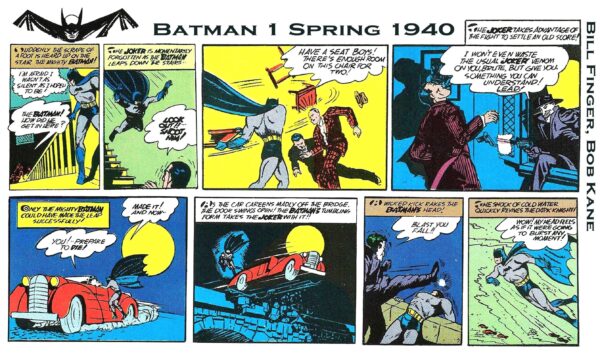
In his seminal 1965 hardcover The Great Comic Book Heroes, cartoonist Jules Feiffer featured the Masked Manhunter’s first run-in with the Joker in Batman 1 (Spring 1940).
“The Batman school (of comic book fans) preferred a vulnerable hero to an invulnerable one, preferred a hero who was able to take punishment and triumph in the end to a hero who took comparatively little punishment, just dished it out,” Feiffer wrote. “I suspect the Batman school of having healthier egos.”
The Joker, too, had quite the ego, but hardly a healthy one.
The Clown Prince of Crime was introduced while engaged in the time-honored supervillain tradition of threatening the population over the mass media (in this case, radio).
A terrorist as well as a thief, the Joker announced his crimes ahead of time to taunt the helpless and hapless police, then left his poisoned victims dead with an unhappy smile on their faces. Only one man (and a boy) could stop him.
“Batman’s world was scary; Superman’s, never,” Feiffer wrote, noting that the feature “…combined Terry and the Pirates-style drawing with Dick Tracy-style villains, e.g., the Joker, the Penguin. The Catwoman, the Scarecrow, the Riddler, Clayface, Two-Face, Dr. Death, Hugo Strange.”
The most popular of the lot was the Joker, of course. These days, at times, I find the green-haired psychopath a little TOO popular.
Too frequently, you see a t-shirt meme that says, “Childhood is when you idolize Batman. Adulthood is when you realize the Joker makes more sense.”
This sentiment, idolizing a psychopathic murderer, is actually pretty disgusting, indicative of amoral, degraded, and deluded 21st-century attitudes.
As my friend Mitchell Brown put it, “Personally, I’m not surprised the Joker gets the majority of attention in the Batman universe (and the DCU in general, given Batman’s own outsized importance in the franchise). Joker is the id personified, the logical result of a society in which everything is relative and we’re supposed to ‘understand’ killers/child molesters/etc as products of their environment (‘dipped in a vat of chemicals’) with zero personal responsibility for their actions.
“That’s why, as I get older, The Killing Joke looks less appealing as a story — the whole point of the plot, as far as I can tell, is Joker telling Batman that all it takes is one bad day for anyone to go insane.
“Well, we all have ‘one bad day’ — and many other days beyond that. So we can either choose to continue reliving that one bad day over and over and blame everything in our lives we can’t overcome on that one bad day, OR we can wake up the next day, dust ourselves off, prove we’re stronger than an unpleasant 24 hours and act like a f**ing adult.”
“So I guess what I’m saying is yes, totally agree this T-shirt makes me roll my eyes so hard that Richter fellow is revising his numbers.”
In fact, this supposedly mature t-shirt sentiment is immature. The Joker remains a predatory child on Kohlberg’s scale of moral development, while Batman is a fully morally developed human being.
Superheroes represent the enduring ethical values required by the human condition, among them courage, honesty, decency, wisdom, and compassion. Those values don’t “evolve.” They merely become clarified or confused, depending upon whether our society advances or erodes.
And the evils of the world should give us MORE reason to respect and admire the morality of superheroes, not less. Superheroes were born out of the Depression because the world was in moral chaos then, too.
About Author
