
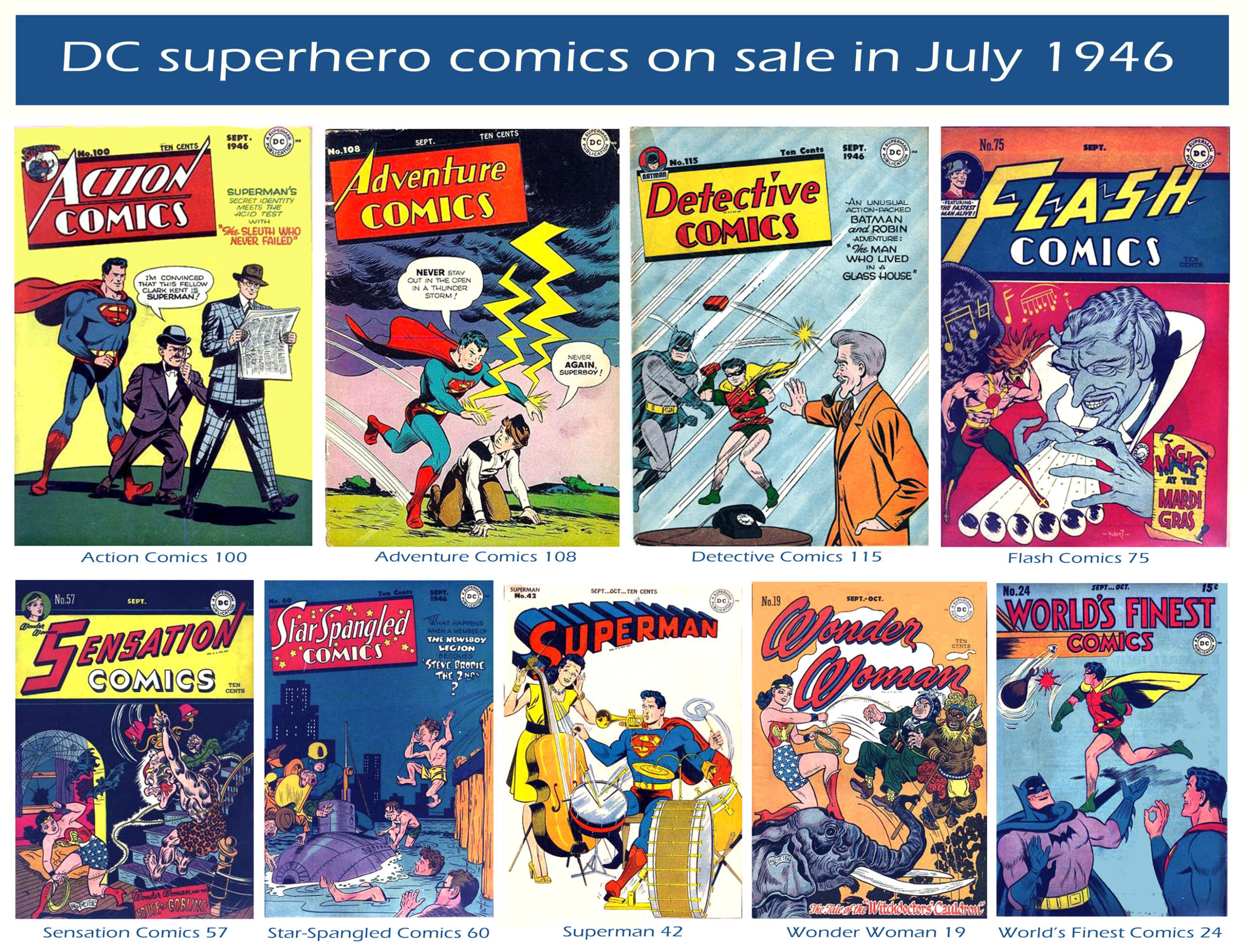
The covers started getting softer and sillier in the postwar era. We’d had enough violence for a while.
In fact, we had actually FRIGHTENED ourselves with our violence, after those two detonations in the east.
“I think there’s something to be said for that notion of war weariness,” Philip Rushton observed. “It’s notable that war stories largely vanished from British comics for about ten years after 1945, only to become more popular than ever from the late 1950s when a new generation had grown up for whom WW2 was ancient history.”
Sam Kujava said, “Postwar DC is just about my favorite comics collecting era. Not sure why… the books are hard to find, and expensive when you do.”
One advantage is that the elemental but rather crude art of the 1930s had evolved nicely by then.
“I really enjoyed the late 40s’ art in the former AA titles Flash, Green Lantern, All-Flash and All-American,” Bob Bailey said. “It had improved greatly in these rarely reprinted books with art by Carmine Infantino, Alex Toth, Lee Elias, and the venerable Irwin Hasen.”
Outside comics that month, justice was sometimes in short supply. A mob murdered two African-American couples near Moore’s Ford Bridge in Georgia in the U.S.’s last mass lynching.
Dean Martin and Jerry Lewis performed as a comedy team for the first time.
The surplus USS Saratoga was sunk near Bikini Atoll in the Pacific during the first underwater test of the atomic bomb, and bikini swimsuits went on sale in Paris.
“French women welcomed the design, but the Catholic Church, some media, and a majority of the public initially thought the design was risqué or even scandalous,” Wikipedia noted.
About Author
