
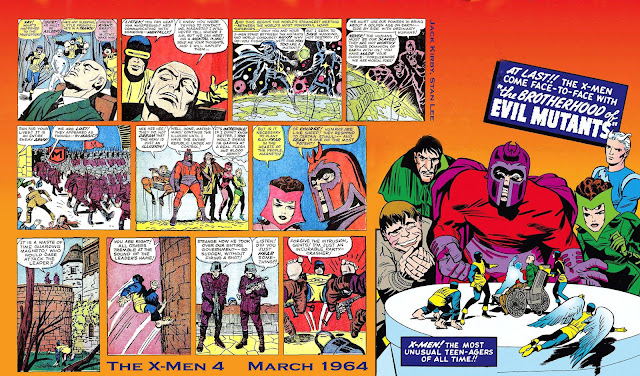
Behind the straightforward superhero battles, the early X-Men comics offer us an insistent subtext concerning manipulation.
In The X-Men 2 (Nov. 1963), Prof. Charles Xavier telepathically robs the super-villain of his powers and identity.
In The X-Men 3 (Jan. 1964), Xavier irradiates criminal carnival workers with his Electronic Mass Influencer, inducing amnesia.
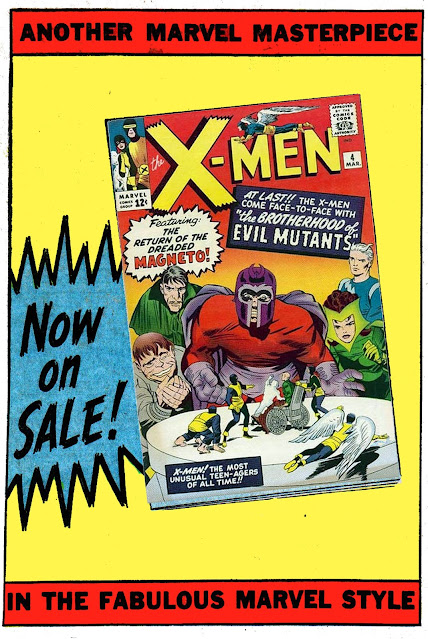 Then, in The X-Men 4 (March 1964), everybody gets into the act.
When Quicksilver wants to take Scarlet Witch away from Magneto’s Brotherhood of Evil Mutants, the mutant terrorist manipulates them into staying by reminding them that he once saved her life, which she now owes him.
When the Brotherhood attacks the republic of San Marco, Mastermind manipulates the citizenry by projecting the illusion of an invading army. These goose-stepping troops have a distinctly fascist vibe, reminding us that the men who created the story were World War II veterans.
“Humans are like sheep,” Magneto gloats. “They respond to certain stimuli — and fear is one of the most potent!”
“The cover is a knockout, with the towering villains each revealing a bit of their unique character and personality traits as they loom over the tiny X-Men figures,” observed comics historian Vincent Mariani. “But it is in the potential for later storylines that marks this book as a classic.”
At the story’s climax, Professor X leaps from his wheelchair to save the Beast from a hidden bomb and is knocked senseless. When he revives, he tells his students that he’s been robbed of his powers.
And that was a manipulation.
At the end of The X-Men 5 (M
ay 1964), Xavier informs the team that he only pretended to be powerless so they could prove themselves.
I’m always a little surprised that the X-Men weren’t worried about being mentally controlled by Professor X early on. Being suspicious of what a powerful telepath might be up to would seem only reasonable to me. But then, after all, maybe Xavier was making sure they didn’t think about that…
About Author
