

At first, the alien warrior Captain Marvel was essentially a Fantastic Four spinoff.
Publisher Martin Goodman wanted a superhero with the legendary — and now legally available— name “Captain Marvel.”
“Martin Goodman hated when people thought that Marvel Comics published the original (1940s) Captain Marvel,” Roy Thomas recalled. “When the name fell out of copyright, he quickly commissioned Stan Lee to use it.”
But what to do with it?
The Marvel Comics iteration would veer far from winsome boys who shouted magic words. The new Captain Marvel was an alien saboteur who initially merely posed as a champion of humanity.
“Lee worked with artist Gene Colan to create a superhero who was one of the Kree, an alien race recently introduced in Fantastic Four,” Thomas wrote. “The spaceman’s given name was Mar-Vell, and his rank was, of course, Captain.”
“(H)e masqueraded as an Earth superhero while furthering his Kree agenda,” noted comics historian Don Markstein. “But he quickly developed greater sympathy for humans than for his species, resulting in his ouster from the Kree military and exile from their territory.”
In addition to superhuman strength resulting from his birth on a heavy gravity planet, Mar-Vell sported green-and-white battle armor that masked his appearance, an air-jet belt for flight, and a wrist-mounted Universal Beam Projector that could blind opponents or disintegrate (and re-integrate) obstacles.
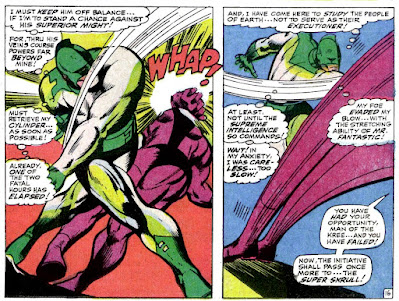
Over the course of his first three appearances, the space-born hero disposed of a renegade Kree Sentry robot. The FF had first battled the Sentry in Fantastic Four 64 (July 1967).
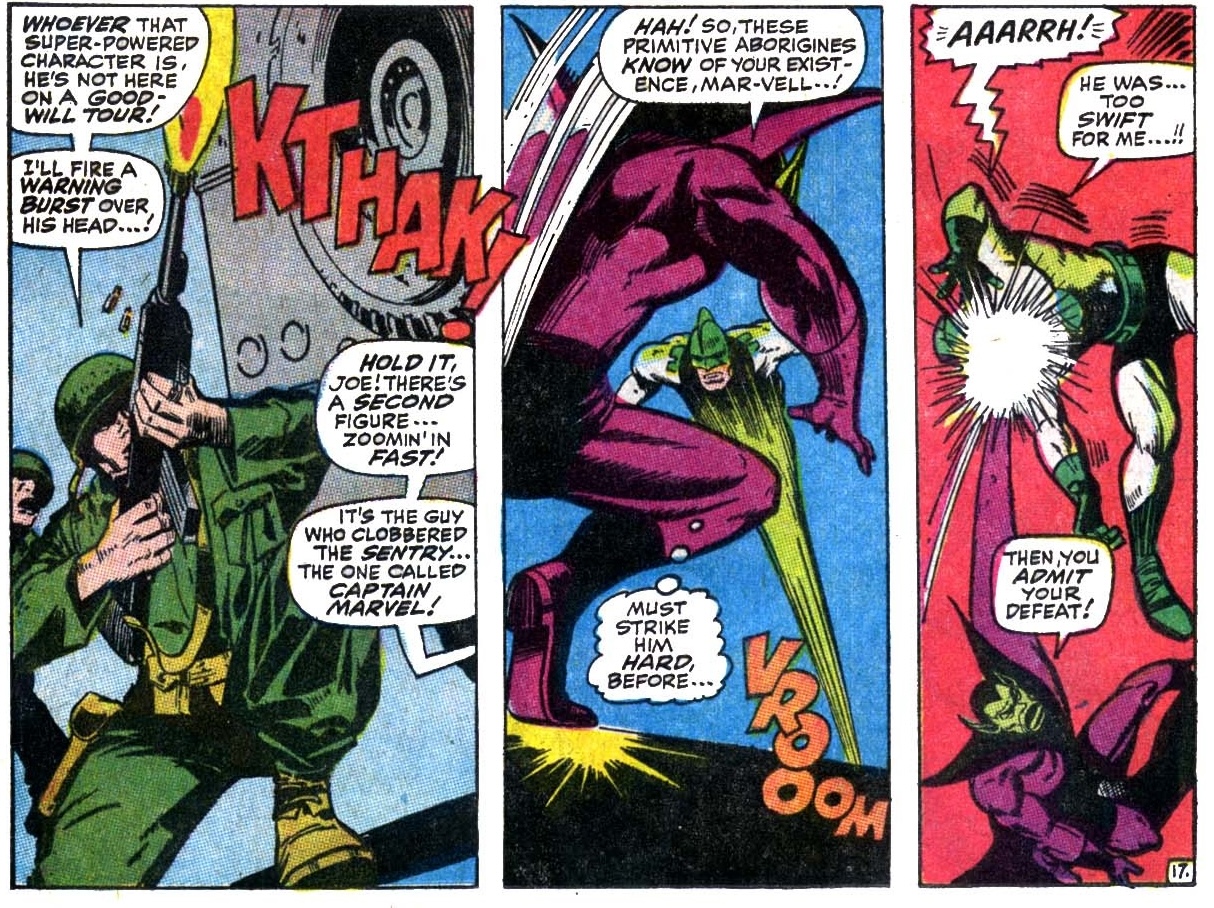
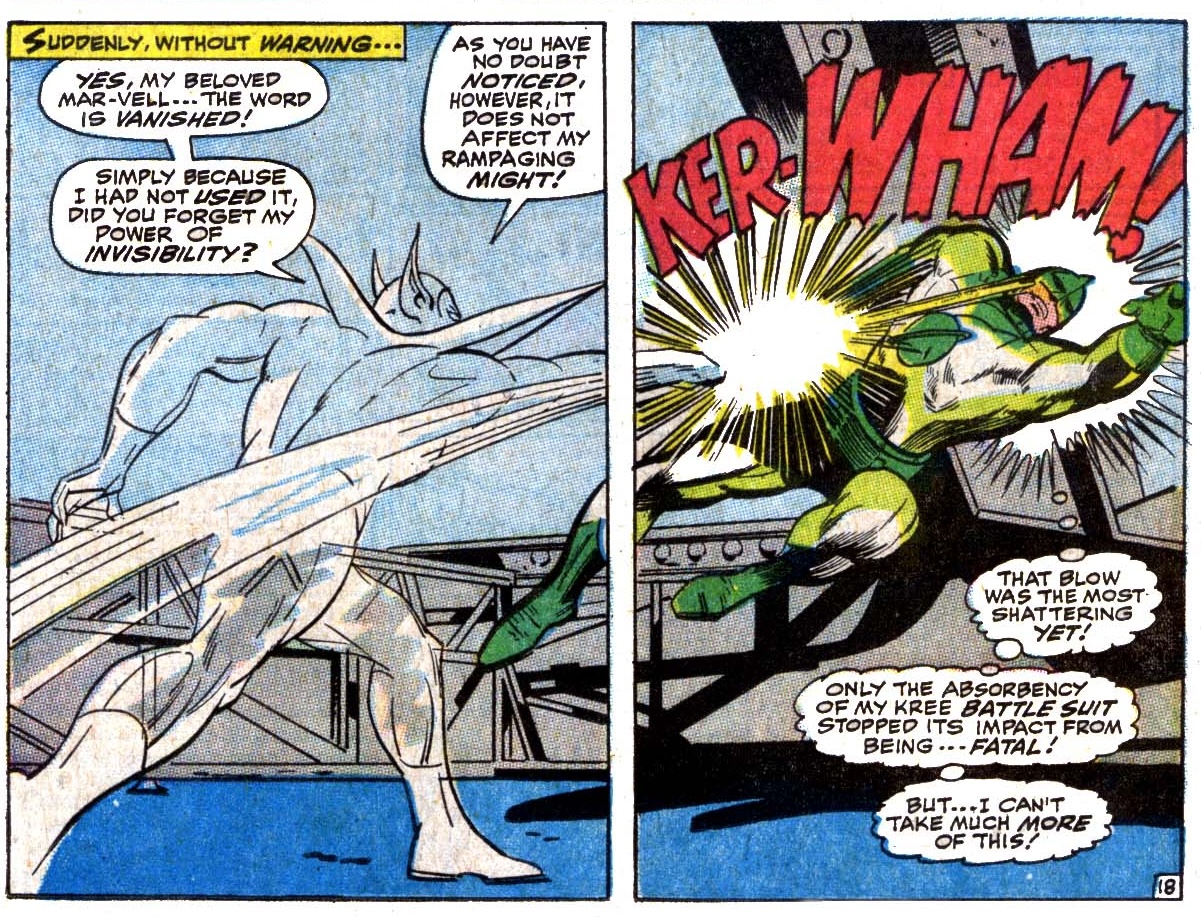
Ready to tackle a new menace in the second issue of his title, Mar-Vell fought an archenemy of the FF, the Super-Skrull (the Kree and the Skrulls being rival galactic empires). And his next foe would be yet another long-time FF nemesis, the Sub-Mariner.
Why such a strong Fantastic Four connection?
“Stan Lee later told a group of college students that the project was initiated by an animation studio that wanted Marvel to create a character by that name so that they could adapt it to television,” noted John Wells in TwoMorrows’ American Comic Book Chronicles. “Moreover, Don and Maggie Thompson reported, the studio had ‘a list of things that had to be incorporated into the character — outer space origin, member of another race, etc.’”
“Lee accepted the assignment grudgingly and grasped for a hook to build a story on. Inspiration came in his and Jack Kirby’s recent Fantastic Four 64-65 (July-Aug 1967), wherein its quartet of heroes inadvertently triggered the deactivation of an ancient Sentry who, like Dell’s Neutro, had been left on Earth long ago.”
So a character that had been imposed on Marvel by an animation studio was refashioned into one that had seemingly evolved naturally from Marvel’s expanding universe. Lee quickly turned the writing assignment over to Roy Thomas.
“I’m fond of early Captain Marvel, with its admirable but deeply divided protagonist,” Matthew Grossman wrote. “Solid art by Gene Colan, too. Odd character in that he had so many wildly varying iterations, and the interpretations that worked did so for completely different reasons.”
“I agree about the character as originally conceived,” said Foster H. Coker III. “His conversion to Earth-protecting hero was a little too quick, in my retrospective opinion. They could have had him take several more steps towards completing his Kree mission before he rebelled.”
“Colan gave the character solidity, particularly regarding the costume, with the helmet and that chunky belt,” Keith W. Williams observed. “A great look. I was very sorry when it later got ditched. I’m probably in a tiny minority in this, but I preferred the space-born warrior CM to the later cosmically aware costumed-superhero version.”
About Author
