
In Stephen Sondheim and James Lapine’s musical Into the Woods, the tree enchanted by her mother’s spirit asks Cinderella: “Are you sure that what you wish is what you want?”
It’s a question that seems simple at first, but becomes increasingly less so the more you consider it.
Superhero comics naturally focus on the joys of awesome power, but other stories have taken a different angle.
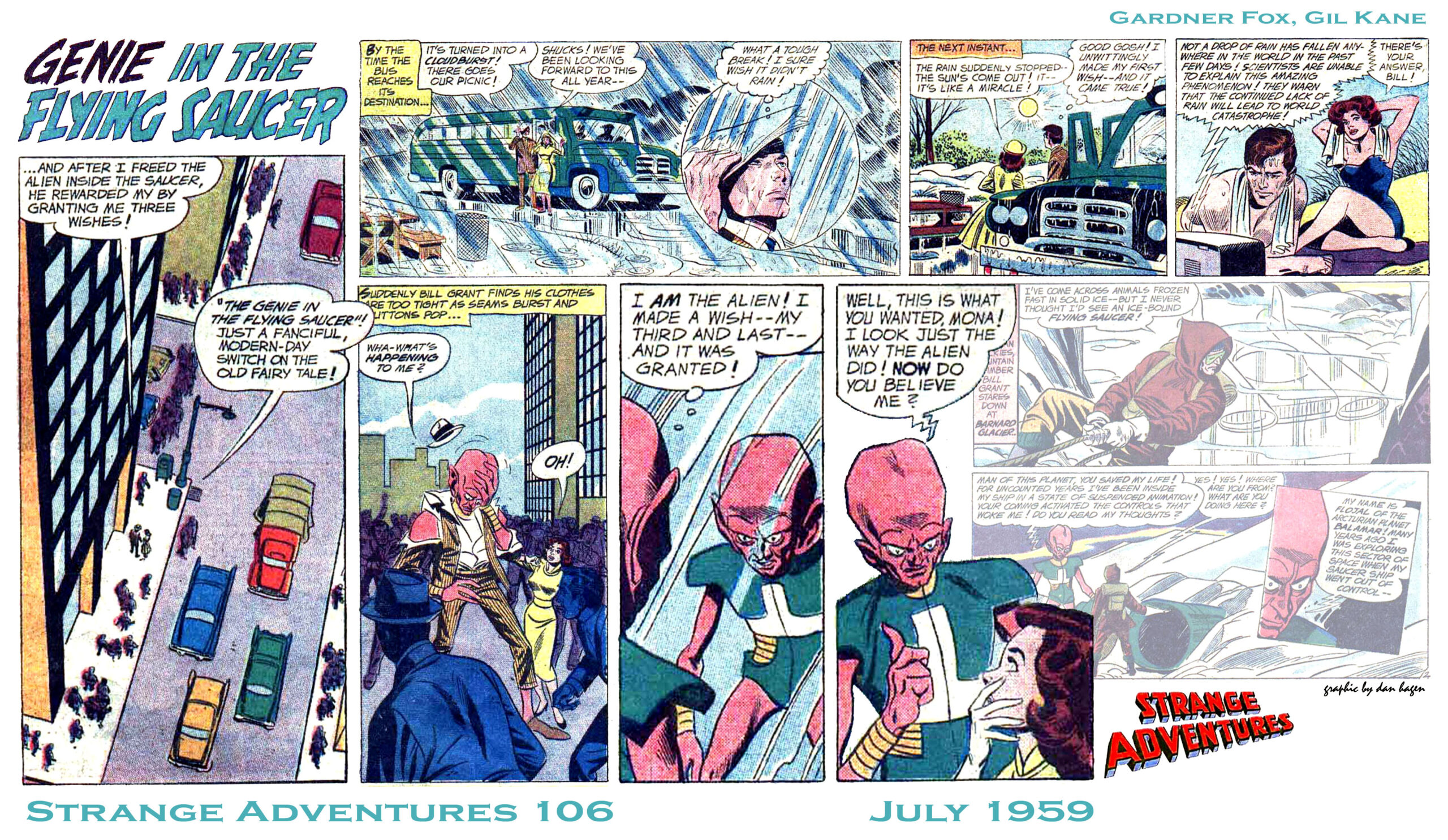
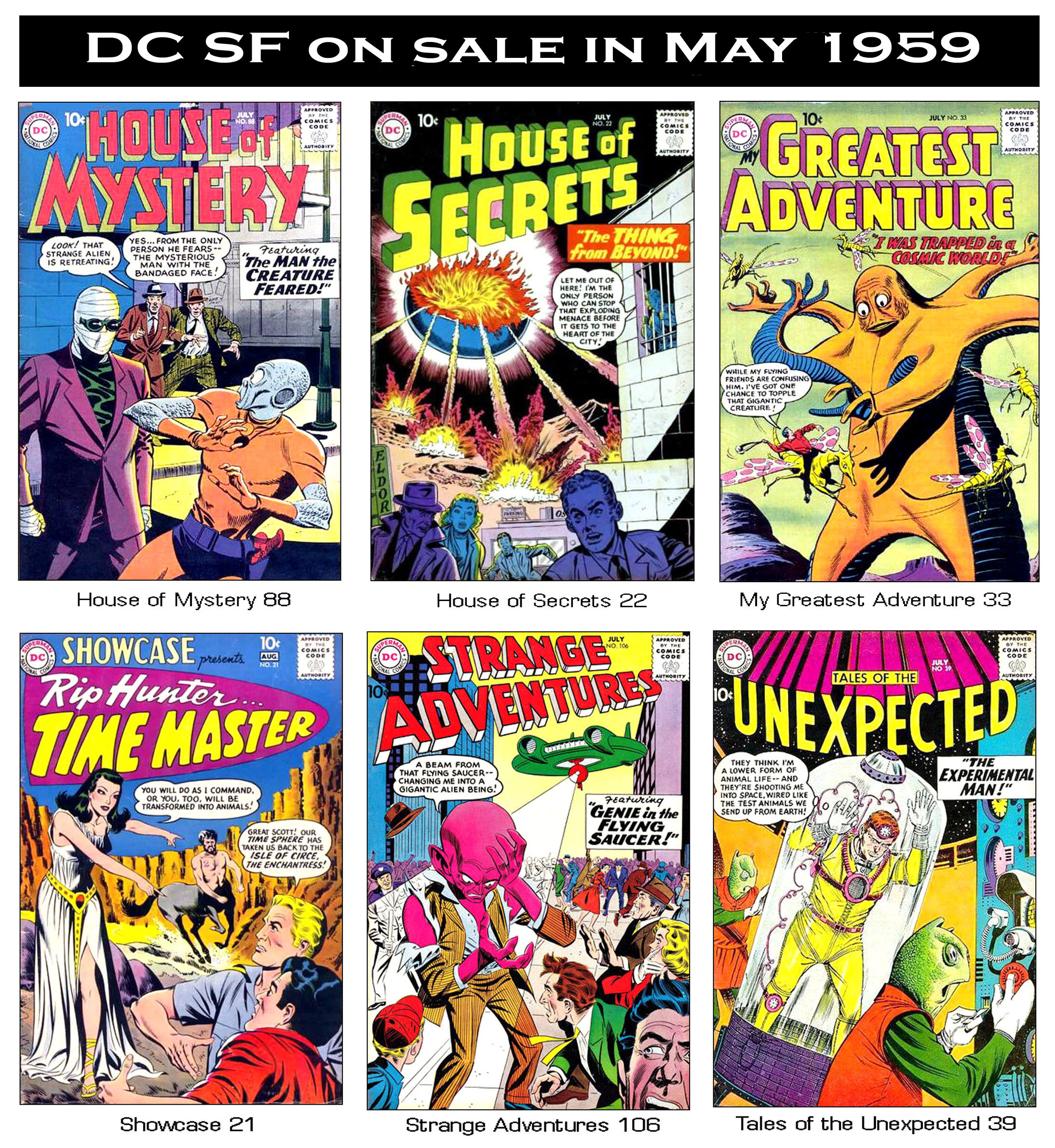
In Strange Adventures 106 (July 1959), the story Genie in the Flying Saucer! Provides a cautionary version of the same folk tale that inspired Green Lantern (remember that the first Green Lantern, Alan Scott’s name was originally supposed to be “Alan Ladd,” i.e., “Aladdin”).
 Artist Gil Kane and writer Gardner Fox take us “…high on a windswept peak in the Alaskan Rockies,” where mountain climber Bill Grant finds an icebound flying saucer in Barnard Glacier, and frees its inhabitant with his mountain axe.
“Man of this planet, you saved my life!” says the shocking pink big-brained alien. “For uncounted years, I’ve been inside my ship in a state of suspended animation! Your coming activated the controls that woke me! Do you read my thoughts?”
The alien, Flojal of the Arcturian planet Balamar, offers to grant Grant three wishes with his reality-bending mental powers.
“Three wishes!” Grant thinks on his flight home. “I’ve got to be careful not to waste them! I’ll have to give this plenty of thought!”
But he doesn’t.
Joining his school teacher girlfriend Mona Lewis on a class picnic, Grant wastes his first wish making the rain vanish. Then, finding that he has caused a worldwide drought, Grant expends his second wish to correct the first, leaving only one wish left.
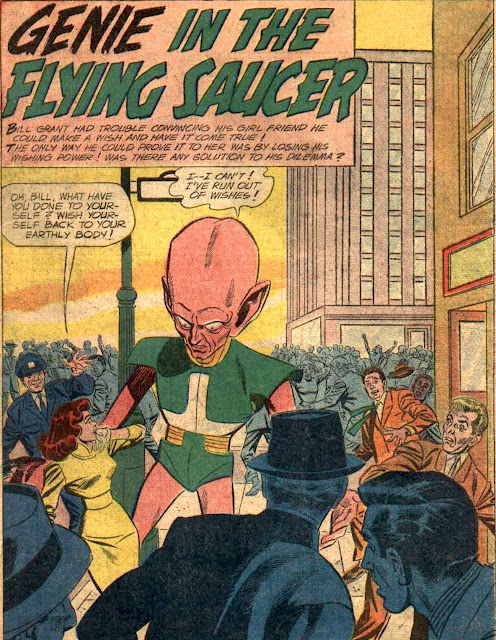
When Mona angrily mocks his belief that he started and stopped the drought, Grant wishes he could show her what the alien looked like — and instantly turns into a Balamarian.
She’s convinced, but he’s stuck — or so he thinks. An unexpected fourth wish undoes everything that has happened.
Whisked back to Alaska days before, Grant learns from Flojal that although he had indeed used up his wishes, by transforming himself into a Balamarian, he had gained unlimited mental powers of his own — until he used them to become human again.
“If I’d realized that — what wonderful things I could have done for mankind!” Grant thinks. “Still, maybe it’s better this way! Man must make his destiny by his efforts, not by wishes!”
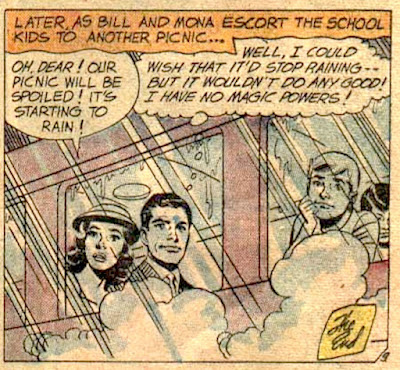
So this time, the school picnic is rained out.
 “The plot does unusually logical things with the idea of wishes,” noted comics historian Michael E. Grost. “Fox looks under the surface of this idea, trying to find its logical consequences and implications. He eventually bends its paradigm in strange ways. The whole effect reminds one of Fox’s treatment of the Absorbascon in Hawkman, where Fox also tried to find subtle implications of ideas.”
This theme — the danger of vast, whim-based power — was occasionally explored in superhero stories, for example, in the Mike Friedrich-penned Thoroughly Modern Mayhem! in Green Lantern 61 (June 1968).
In his imposing pink-skinned alien form, Grant could have been a superhero, but his frightening experiences left him content to be just plain Bill.
And then, only two months later, in a similar situation drawn by the same artist, Hal Jordan would make a different decision about immense power (SOS Green Lantern, Showcase 22, Sept-Oct 1959).
About Author
